Joshit
Mohanty
Ph.D. Candidate · Modeling & Simulation
I build simulations of systems that misbehave. Agent-based models, digital twins, and applied AI for wherever individual decisions aggregate into system-wide dysfunction.

Education and research
Built for & funded by
Worked at & launched with

Recognised by
Trajectory
Where the work happened.
Ph.D. Candidate, Engineering Management & Systems Engineering
- Complex systems, simulation, and organizational modeling.
- Advisor: Dr. Andrew J. Collins.
Senior Research Engineer, Digital Twins
Research Scientist, Modeling & Simulation
- Agent-based simulation, 300M+ scenarios on AWS HPC.
- US medical residency matching market, 42,000+ applicants. NSF EAGER Grant #2333570 ($198,534).
- 7,000+ algorithm generations testing agent behavior evolution.
Technical Program Lead, Fleet Analytics
- $496K across 3 concurrent programs as Co-PI.
- NLP pipeline: 160,000+ records, 92% accuracy, 87% time reduction. In production.
- Proposals securing $350K+ in federal funding.
Strategy Lead
- Zero to $98K revenue in 8 weeks, 5+ clients.
- Carbon tracking simulation under Verra VCS 4.7 and UN SDG standards.
- Improved workforce compliance 25%, ESG reporting efficiency 19%.
Program Director
- $100K product launch, 12-person team, 18% ahead of schedule.
Systems Engineer
- Designed and prototyped CubeSat using shape memory alloy technology.
- Launched aboard SpaceX Falcon Heavy to low-Earth orbit. Still operational.
Interactive
How application fever
spreads.
Every year roughly 48,000 US medical graduates compete for residency posts through a single centralised match. Nobody can see how much competition they face, so applicants copy the strategy of whoever outranks them and send more and more applications, until the volume overwhelms the people reading them.
Selected work
Systems that shipped.
And the models behind them.
Taking the work to the room.
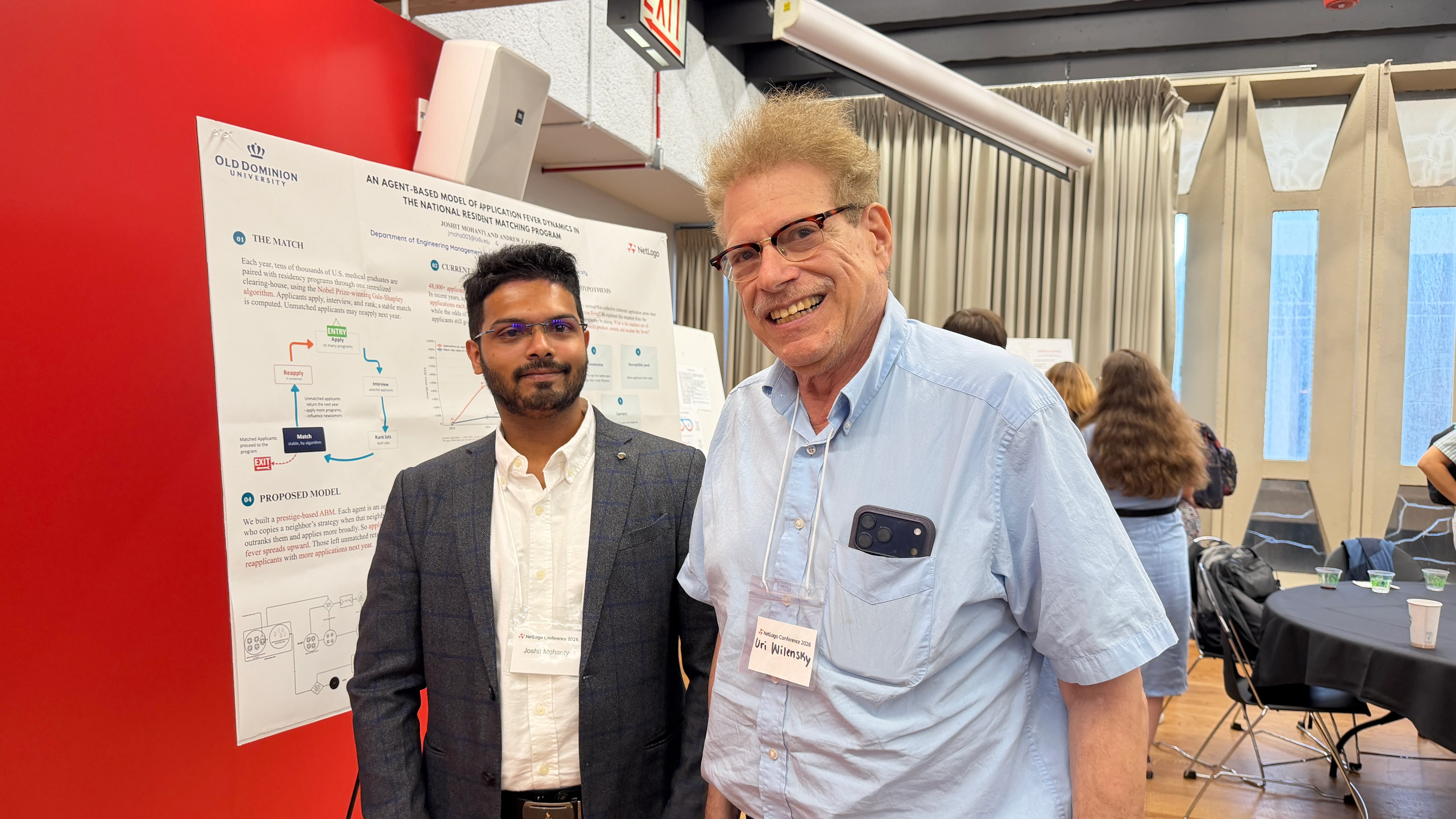
With Uri Wilensky, creator of NetLogo, at the first NetLogo Conference, Chicago 2026.
Dissertation
Dual-Perspective Measurement for Agent-Based Models
Testing the Adequacy of the Single-Perspective Measurement Convention
Dissertation proposal · August 2026
Agent-based models are almost always measured from the population perspective alone. That convention assumes one perspective is enough to describe a final state. The assumption is untested.
Can disagreement between the independently measured agent perspective and population perspective be detected at the final state of a simulation?
Which parameters most strongly influence the probability that the two perspectives disagree?
Method
Axelrod (1997) cultural dissemination model as testbed. Full factorial design across a toroidal lattice and a scale-free network. No new model and no changed rules, so any disagreement belongs to the measurements rather than the model.
Capabilities
Modeling & Simulation
AI Governance & Compliance
Digital Twin & Architecture
NLP & Applied AI
Space Systems
Program Leadership
Mechanical Modeling & Simulation
Publications
32 papers.
Complex Systems Engineering.
Detecting the Silo Trap in Multi-Agent Systems: A NetLogo Framework for Measuring Perspective Divergence
Application Fever as Emergent Behavior: An Agent-Based Model of Medical Residency Matching
A vs. I in AI: Is there a Threshold to "Engineered" Intelligence?
doi:10.24251/HICSS.2026.143From PBFT to Blockchain: A Comprehensive Survey of Byzantine Fault-Tolerant Consensus
doi:10.1109/ICISS67859.2026.11453852A Meta-Clustering Framework for Enhancing Conversational AI in the Healthcare Sector
doi:10.1109/SoSE66311.2025.11083870Bridging Emotions and Architecture: Sentiment Analysis in Modern Distributed Systems
doi:10.1109/ASSIC64892.2025.11158682Digital Twin for Smart Societies: A Catalyst for Inclusive and Accessible Healthcare
doi:10.36227/techrxiv.173921138.87440719/v1Enhancing Document Intelligence by Mitigating Hallucinations in Large Language Models
Navigating the Frontier: Integrating Emerging Biomedical Technologies into Modern Healthcare
doi:10.1016/B978-0-443-22038-8.00015-5Carbon Accountability Scores: A Process-Oriented Approach for Carbon Offsetting Using AI Agents
Digital Thread: Bridging Macro–Micro Services in System-of-Systems
GraphTreeMed: A Hybrid Graph-Tree RAG Architecture for Mission-Critical Medical Applications
Meta-Clustering for Specialized Language Models: Enhancing Contextual Adaptation and Mitigating Hallucinations in Diverse Healthcare Environments
TAMOS: Task-Aware Multi-Agent Orchestrator System
Innovative Water Electrolysis Propulsion Systems for Small Satellites and Deep-Space Missions: A Scoping Review
Reinforcement Learning for Optimal Kicking Actions in Humanoid Robotics
Integrative Machine Learning Approaches for Enhanced Classification of Genomic Sequences: A Next-Generation Sequencing Perspective
Improving Neuropathological Analysis with AβGAN: Addressing Morphology Imbalance for Efficient Alzheimer's Disease Diagnosis
doi:10.36227/techrxiv.173386099.92841064/v1Analysis of Space Debris Mitigation and Removal Techniques for Small Satellites in Low Earth Orbit in Purview of the FCC Guidelines
Automated Prioritization of Maintenance Work Orders: A Sentiment Analysis Approach Using Natural Language Processing
Integrating Generative A.I. with Systems Thinking: Making Remote Teams More Efficient
Digital Twin for Smart Societies: A Catalyst for Inclusivity and Growth
An Analytical Outlook of the Commercial Space Industry for the Last Frontier: Potential Entrepreneurial Evaluation of the African Space Sector
doi:10.1089/space.2020.0016Nanofluid Based Active Thermal Control System for Spacecraft
Conceptual Design of a Mars Constellation for Global Communication Services using Small Satellites
A Systems Engineering Approach to Developing Logistics Architecture for the First Crewed Mission to Mars
Interplanetary Communication Architecture for Future Human Settlements
Rocket Model with Implementation of Advantages of Additive Technology
Drone-LiDAR Agricultural Land Monitoring System
Fault Detection System using GSM Technology
Energy Harvesting on Aircrafts: Static Charge Energy Generation using Graphene
No papers match that filter.
The record
Awarded research grants
EAGER: Demonstration of Scaling Impact on Coalition Formation in Agent-based Simulation ↗
Corrosion Management System (CMS)
Sentiment AI to Analyze and Prioritize Ship Work Orders
Media coverage
In the field
Conferences, labs, launches.
Contact
Let's build a model
of the thing you can't measure.
Modeling & Simulation · Operations Research · Applied AI · Digital Twin Architecture